Qayoom Suroush
Afghanistan Observatory Scholar

When the Taliban swept into Kabul a little more than year ago on August 15, 2021, life changed for millions of Afghans overnight. Soldiers, government officials, police, and female nurses and teachers鈥攁lmost all lost their jobs. Many who had worked with U.S. and NATO forces were forced to flee amid a chaotic government collapse that left the country鈥檚 economy in freefall. But, there was one group who managed somehow to survive and thrive despite the unprecedented humanitarian crisis brought on by U.S. sanctions against the Taliban regime: Afghanistan鈥檚 moneymen.
Known colloquially as "hawaladars," the men鈥攁nd they are almost exclusively men鈥攚ho run Afghanistan鈥檚 multibillion dollar informal banking system have long been at the center of power in the country. After the United States withdrew its troops, Washington froze access to nearly $9 billion in funding left in reserves in Afghanistan鈥檚 central bank. Now, one year on, as a result, the country鈥檚 moneymen, the hawaladars, are at the heart of a battle for the future economic stability of the country. The Taliban鈥檚 government is cash strapped while many civil servants remain unpaid and average Afghans in many parts of the country are starving. Millions of Afghans were unbanked before the Taliban takeover but now almost everyone depends on hawaladars for the most basic of financial transactions and what makes money flow more readily is in no small part the Taliban鈥檚 influence鈥攐r sometimes lack thereof鈥攐ver Afghanistan鈥檚 illicit opium trade.
Before the government of Afghanistan鈥檚 last president, Ashraf Ghani, was ousted last summer, a total of 741 money exchange service providers were officially registered in the country, according to kept by Da Afghanistan Bank, or DAB, as the country鈥檚 central bank is also known. Thousands of unofficial, unregistered hawaladars, however, operate across Afghanistan. Quite a few are actually wholesale textile traders or have medical supply companies whose large volume of business draws large amounts of cash from neighboring markets in Pakistan and Iran, making them an ideal one-stop shop for informal banking. They trade in open air markets and at shop stalls in cities and villages in all 34 of Afghanistan鈥檚 provinces. Yet, hawaladar money exchanges are one of the least well tracked and least understood gears in the financial machinery of one of the most impoverished countries in the world.
While the lack of oversight and regulation of Afghanistan鈥檚 hawaladar money exchanges is very much a legacy of Hamid Karzai鈥檚 and Ashraf Ghani鈥檚 government, the unregulated flows of billions in cash that slushes through the hawaladar market is one of the most vivid illustrations of the failure of U.S. efforts to reconstruct the country鈥檚 ailing economy after decades of war. The gray market economy that energized the hawala system simultaneously funded the anti-American insurgency and hollowed out the Afghan government by making it possible for anyone looking to profit from corruption to do so with impunity. The U.S.-backed Afghan government鈥檚 failure to implement and enforce the regulation of hawala money exchanges was a boon for the Taliban鈥檚 leaders; lack of government oversight allowed them to blaze a trail right to the center of power in Kabul. But now, in an ironic twist, the Taliban leaders who, over the last 20-plus years, depended heavily on the informal services of hawaladars to transform opium into dollars that helped them wage war against American and NATO forces are pushing for formal change.
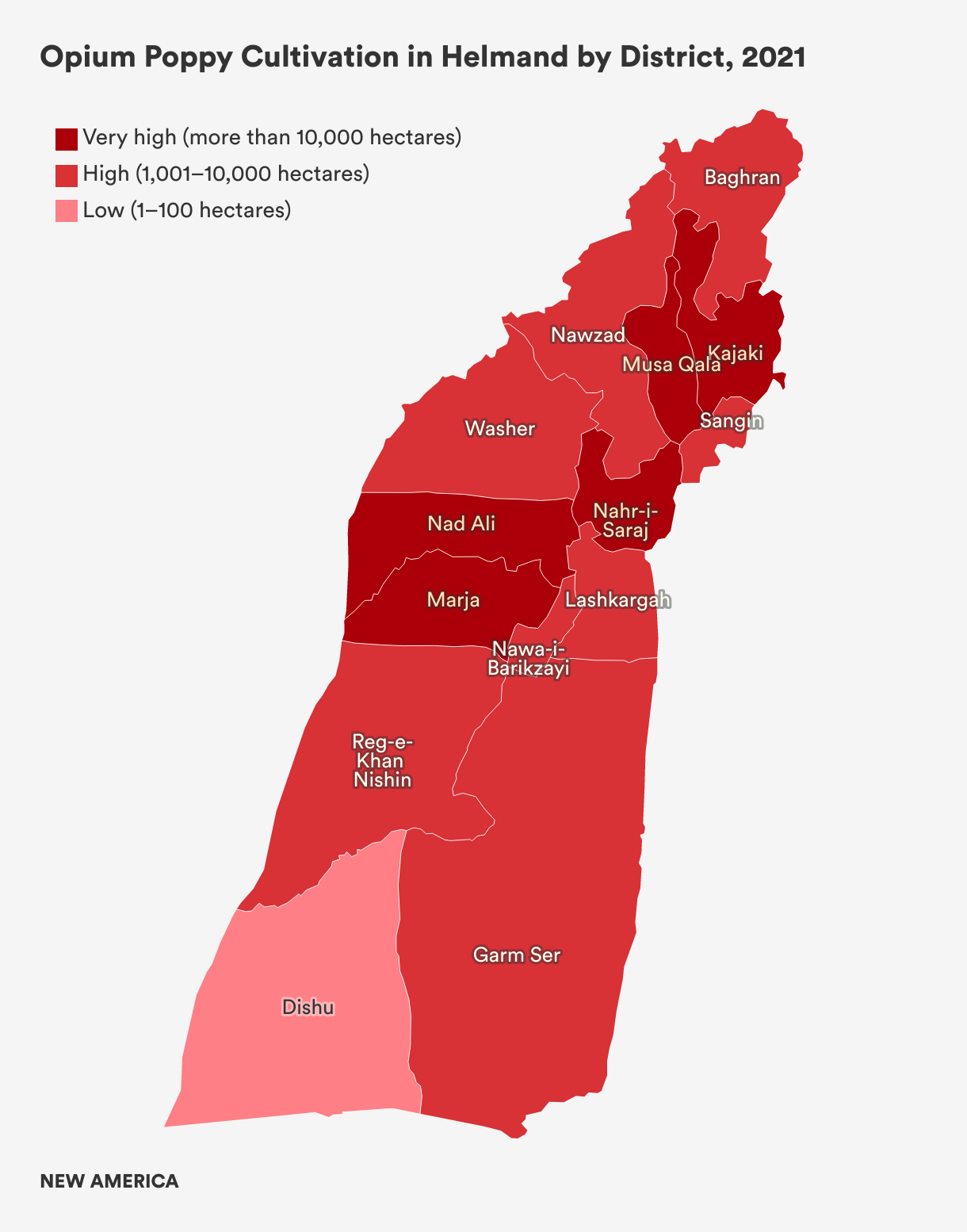
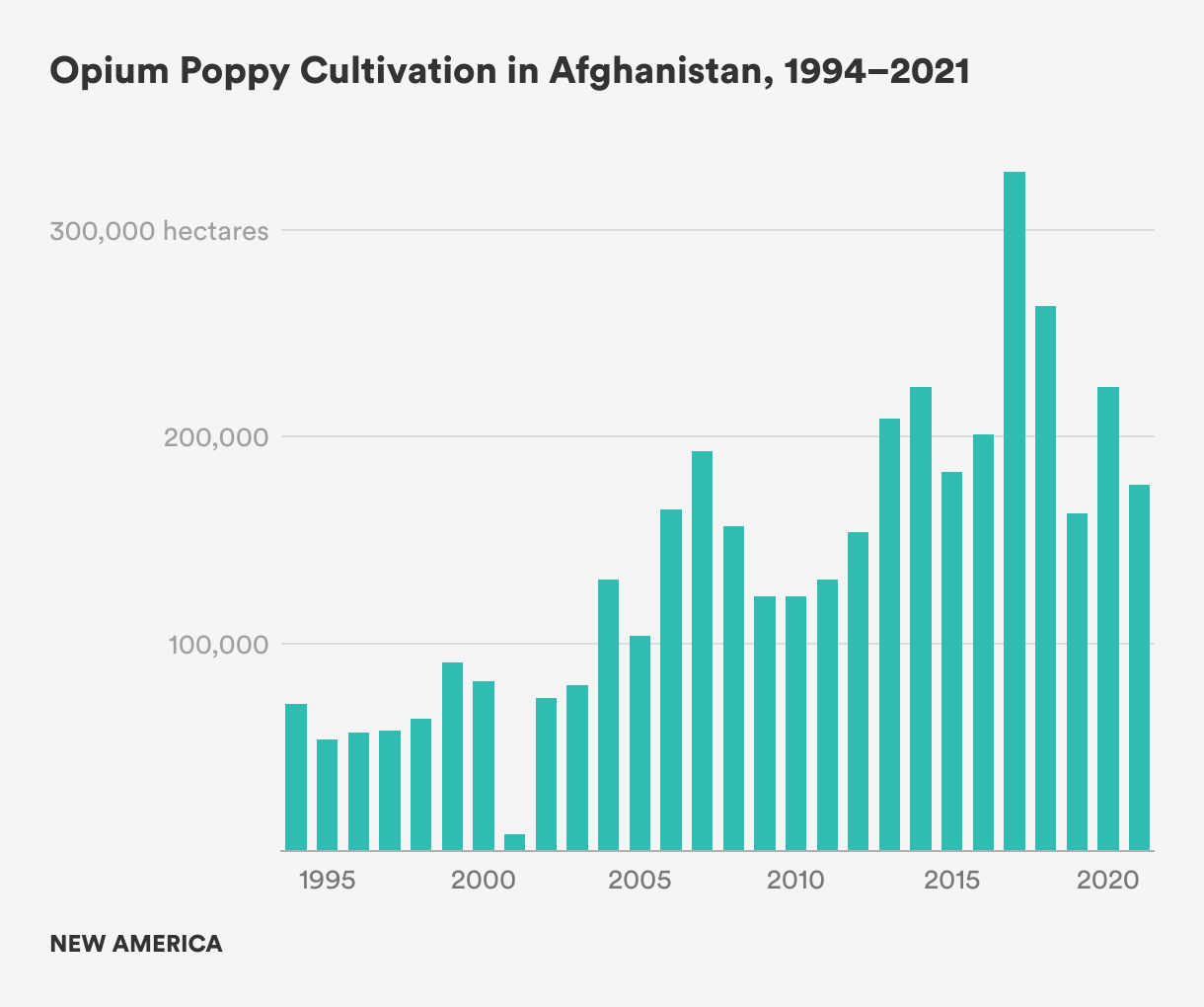
Desperate for both cash and international legitimacy, the Taliban have opted to keep in place regulations first proposed by U.S. advisers and imposed by Ghani鈥檚 government before its collapse. On April 3, 2022, the Taliban banning both the cultivation and trade of opium, but they have not enforced the ban. They have, meanwhile, only destroyed a fraction of the fields though they have asked the farmers not to cultivate drugs during the next season. Media reports suggest that the Taliban鈥檚 efforts to restrict opium cultivation have been limited to the south, in places like Helmand, Farah, and Kandahar, where they enjoy strong social support. But even with a focused approach, the Taliban鈥檚 ban on opium has increased the price dramatically, resulting in more money in drug dealers鈥� pockets and more money being funneled through the hawaladars.
It seems the Taliban have once again turned to Afghanistan's traditional fixers鈥攐pium and money dealers鈥攖o fund their government.
Under the current regulations, hawaladars cannot make loans or hold deposits. They are required to collect information to comply with international Know Your Customer (KYC) regulations, which require the transmission of information on who sends and receives money. Money exchanges must also must file Suspicious Activity Reports (known as SARs) for any customers who could be involved in money laundering, terrorism financing, tax evasion, or narcotics trafficking. Depending on the province, hawaladars must also pay between 150,000-300,000 Afghani (around $1,685-$3,370) as a bank guarantee and have at least five million Afghani as an initial investment, making it difficult for many hawaladars to comply. But it鈥檚 not just the financial factors that are hindering compliance; the Taliban are finding few hawaladars in Helmand who want to comply with the regulations and they are encountering fierce resistance from some of Afghanistan鈥檚 top hawaladars. Without buy-in from the hawaladars, both the Taliban鈥檚 bid for international legitimacy and their attempt at having U.S. sanctions lifted are in danger, not to mention the cash flow from the opium trade could be disrupted.
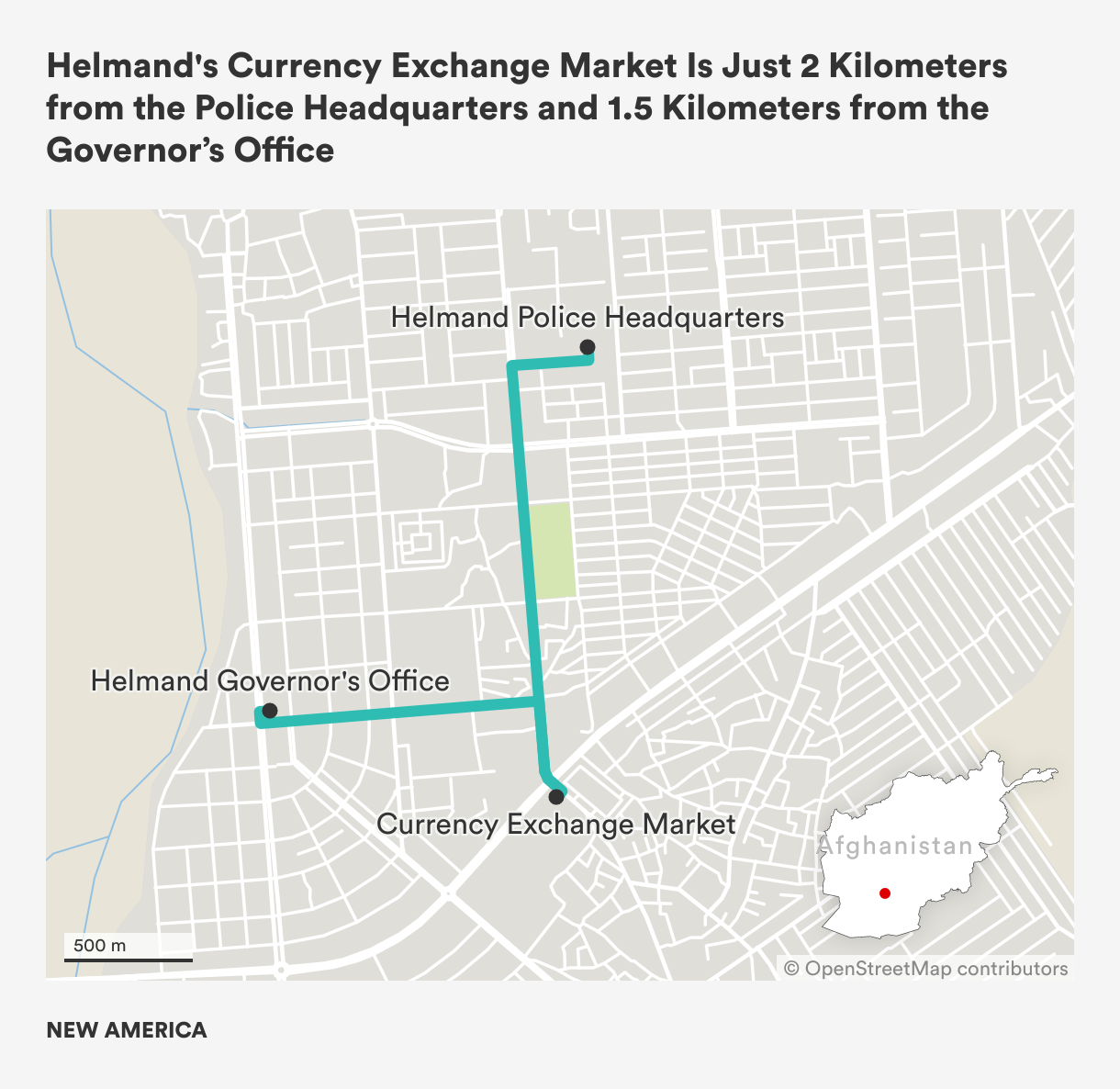
In the southern province of Helmand where, officially, only two hawaladar money exchanges are officially registered with the government, there are actually hundreds operating in the province鈥檚 bustling currency exchange market. With over 1.4 million residents and some 20,000 square miles of land, Helmand is one of the most underpopulated yet most expansive provinces of Afghanistan. It has always been and currently is the center of the Afghan opium trade, and as a result it is the beating heart of the country鈥檚 financial sector. In fact, the best way to think about the role Helmand鈥檚 currency exchange plays in Afghanistan鈥檚 economy is that it operates in ways not dissimilar from Wall Street in New York. Traders from neighboring Iran and Pakistan looking to profit from smuggling routes for everything from opium to big screen TVs often pass through Helmand to liquidate their assets into hard and stable currencies, like U.S. dollars. Opium dealers, in particular, often need to beyond the region to paying customers in Russia, Eastern Europe and beyond. Cash is king in this frontier market hub and trading volumes are exceptionally high among Helmand鈥檚 hawaladars.
The hawala system creates a gray zone鈥攅ven though it鈥檚 technically regulated, even now by the Taliban, the plethora of unofficial and unregistered hawaladars present plenty of opportunities for misuse of the system. Depending on its clients, it can nourish communities in need with remittances from neighboring countries and licit activities. But insurgents and drug cartels also use the hawala system to bypass legal barriers to money laundering. In 2021, the opium trade brought into the country. The cash flow that streams through Afghanistan鈥檚 hawala money exchange markets has financed armies and insurgencies in the country for generations. Afghanistan鈥檚 most politically powerful southern provinces, Helmand and Kandahar, illustrate the strong connection between the hawala money exchange markets and insurgencies. Taliban leaders have often come from long lines of families who essentially worked as sharecroppers in opium fields or were part of the clerical class who serve in rural areas both as judges and enforcers to sort out civil disputes.
Take, for example, the Barakzai tribe. The Barakzai predominantly live in southern Afghanistan and, as the ruling tribe, they own much of the agricultural lands from Lashkargah to Kabul. The Barakzai are one of the main sub-tribes of the Pashtun Durrani tribe that ruled the country from 1747 until 1973, when King Zahir Shah, the last in of the Durrani monarchs was ousted and his cousin Dawood Khan established a parliamentary republic in 1973. For a time, the Barakzais served as viziers, or ministers, to the Popalzai clan, a sub-branch of the Durrani tribe. However, as their power and influence rose, the Barakzai clan sought to supplant the Popalzai. Eventually, in 1826, Dost Mohammad Khan Barakzai declared himself as the amir of Afghanistan, marking the start of a new thrust toward modernity in the country by most accounts.[1] For a little more than 150 years, Afghanistan was ruled largely by the Barakzais until the coup that ousted Mohammed Dawood Khan and precipitated the Soviet invasion in 1978. But the Popalzais again regained power soon after U.S. military incursion in 2001 when Hamid Karzai was elevated as interim president. The Barakzai family, nonetheless, with their vast land holdings in Afghanistan鈥檚 southern provinces remained among the most wealthy and influential.
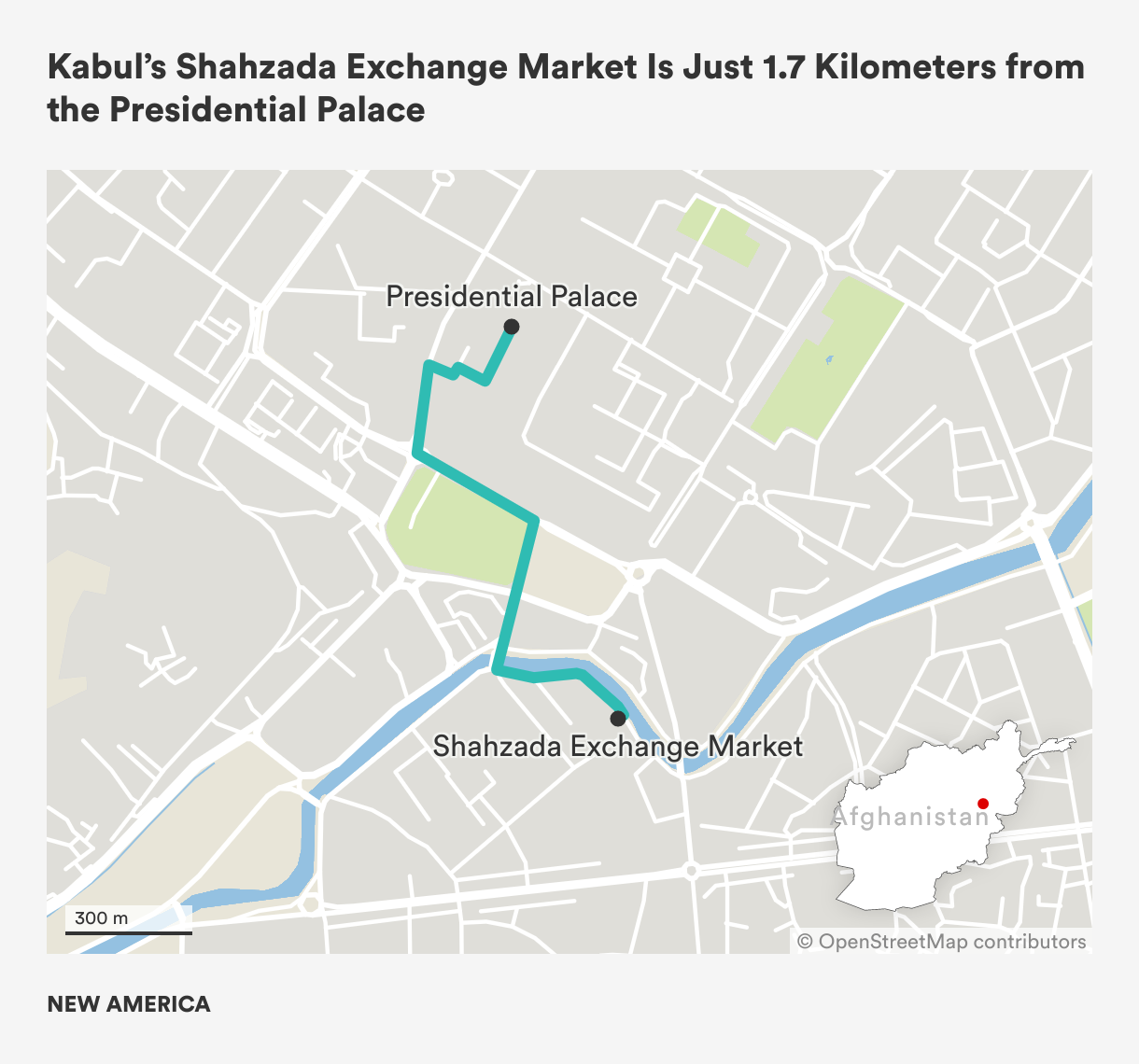
It鈥檚 because of this generational wealth and the multitude of familial connections that Haji Khairullah Barakzai, one of Afghanistan鈥檚 most successful hawaladars, was able to get his start. By the time Khairullah was born, his family was poor, but he inherited capital of another kind: tribal connections and social networks that he used to open his hawala business with trust as the main currency. By the time he reached his 50s, he had built a with hawala shops across Afghanistan, Iran, Dubai, and Pakistan. One Afghan hawaladar who visited his office in Quetta described the amount of cash at his office as "walls of dollars and euros.鈥漑2] By early 2010, Haji Khairullah Barakzai鈥檚 hawala business was thriving. Every day he would drive to Afghanistan's in Kabul and work in Shop Number 257, Haji Khairullah Haji Satter Money Exchange (HKHS), in Sarai Shahzada, a market just a few kilometers to the south of Afghanistan鈥檚 Presidential Palace and the North Atlantic Treaty Organization (NATO)'s headquarters.
Meanwhile, his representatives in Helmand province through fund collections, deposit accounts, and cash transactions for the Taliban's Helmand shadow governor and his fighters. Khairullah had a very close relationship with the then-supreme leader of the Taliban, Mullah Mohammad Omar. In fact, he met Mullah Mohammad Omar, a fiercely private man, , according to one account.
Khairuallah鈥檚 close working relationship with Mullah Mohammad Omar was really just part of the natural historical weave of the local drug economy. Mullah Omar was from the Ghilzai tribe, which once held power in Kandahar but were driven out by Ahmad Shah Durrani in 1747. The Ghilzais lost status and moved to the eastern part of the country where they launched several unsuccessful rebellions against the Afghan monarchy that resulted in further marginalization of the Ghilzai tribe and the imposition of heavy taxes by the country鈥檚 Barakzai and Popalzai leaders.[3] Mullah Omar鈥檚 decision to launch his bid to claim the leadership of Afghanistan in the predominantly Durrani Kandahar in the 1990鈥檚 and again after the U.S. incursion began in 2001 was in many ways reflective of this long tradition of intra-tribal frictions. But partly thanks to his close working relationships with individuals such as Khairullah, the Taliban transformed Afghanistan鈥檚 southern regions into a significant stronghold under Mullah Omar鈥檚 leadership.
Most Afghans use the hawala system, which is one reason why the country has always struggled to establish a more robust formal banking sector. According to the World Bank, only . While Western Union and MoneyGram provide remittance services into the country, these companies for just $789 million in 2020, only 4 percent of the gross domestic product (GDP). By contrast, the hawala system , depending on the province. Some experts that Kabul's main hawala market loan volume is roughly double that of commercial banking.
The hawala system is based on social networks and trust. Afghan hawaladars are typically well connected to all segments of society and transactions are made by a verbal agreement, making it difficult to follow the money or document any transgression.[4] The hawaladars provide a transaction number and a shop address in the recipient鈥檚 province to the sender, and the sender forwards the details to the recipient through WhatsApp or Telegram. The recipient then visits the shop, provides the number, and receives the money. It鈥檚 a perfect conduit for funds generated by the narcotics trade in Afghanistan because it's fast, anonymous, and makes it almost impossible to follow the flow of the money.
Afghanistan鈥檚 opium networks are incredibly inclusive, as market imperatives and financial incentives tend to override religious, political, ethnic, and geographical boundaries.[5] The drug trade is so lucrative that it has even formed the basis of political coalitions. It factors into the alliances that form in civil wars, where local communities use alliances with insurgents as a way to benefit from the drug and illicit economy.[6] U.S. military officials "narco-terror" or "narco-insurgency" to illustrate the two-way relationship between the insurgents and narcotic smugglers. Graeme Smith, one of the leading international correspondents who has reported extensively on Afghanistan鈥檚 southern drug trade, has the relationship between hawaladars, smugglers, and the insurgents as "the iron triangle." Others have called the three-way relationship between smugglers, insurgents, and government figures the "toxic triangle."[7]
But in actuality, there is a four-way relationship in the Afghan drug industry between the insurgents, hawaladars, smugglers, and former government officials. The drug traffickers and insurgents are from the thriving drug economy; many Afghan officials and hawaladars have also profited. Take, for example, the former Helmand governor, Sher Mohammad Akhundzada (SMA). SMA is part of the Alizai tribe and his family played a vital role in shaping the political dynamics in Helmand for over 40 years, where they aided in expanding opium cultivation across the province.[8] In June 2005, the U.S. Drug Enforcement Agency Officials and and found nine tons of opium. In December 2005, SMA was replaced with Mohammad Dawoud as the governor. SMA later confirmed that 3,000 of his fighters had joined the Taliban because he could not pay their salaries following his removal from the governor's office.[9] Now, these symbiotic relationships are being thrown off kilter with the Taliban鈥檚 new regulations on the hawala system and the banning of opium cultivation.
Hawaladars like Khairullah have always helped insurgents and traffickers move their money both domestically and abroad, which is why the U.S. government the Afghan Threat Finance Cell in 2008. The cell used in Iraq and was meant to "attack insurgent funding and financing networks by providing threat finance expertise and actionable intelligence to U.S. civilian and military leaders." This multi-agency intelligence organization was instrumental in exposing corruption and sanctioning hawaladars. The U.S. Department of Treasury started sanctioning Afghan Hawaladars in 2011 with the . The department sanctioned HKHS, Roshan Money Exchange, and Rahat Ltd in 2012; the Etehad Brothers in 2014; and in 2018.
But the hawala system continued to be immune to effective oversight, due in no small part to its immense popularity; in Helmand province, one of the Taliban鈥檚 strongholds over the last 20 years, the intergovernmental Financial Action Task Force (FATF) in 2014 that around 80 percent of transactions were conducted through the hawala system.
In 2017, the Afghanistan Central Bank, under international pressure, adopted measures to regulate the hawala systems. These measures improved transparency: Afghanistan was from the FATF gray-list of deficient jurisdictions. The reform included converting the legal status of monetary services (hawaladars) and money exchangers (saraaf) from sole proprietorships to companies. It also required new licenses to be issued and exchanges to be registered as with increased guarantee fees while banning hawaladars from making loans or holding deposits. Hawaladars were also required to information about the identity of recipeints and senders of funds and to file Suspicious Activity Reports (SARs) on customers allegedly involved in wrongdoing like money laundering, terrorism financing, tax evasion, fraud, or narcotics trafficking, according to the . Hawaladars, under the new rules, also had to pay 300,000 Afghani (around $3,370) in Kabul, 200,000 Afghani or around $2,250 in Herat, Nangarhar, Kandahar, Paktika, Balkh, and Kunduz provinces, and 150,000 Afghani or about $1,685 in other provinces as a bank guarantee. The regulation also requires the hawaladars to have at least five million Afghani as an initial investment, which hawaladars is too much for their small businesses.
The hawaladars and money exchangers have consistently protested against the new regulation since the DAB it in February 2018. The longest strike lasted for 15 days; they their shops only after the then-President Ashraf Ghani got involved. Since most Afghan traders use the hawala system for their business, any long-term closure of the hawala shops could cause a collapse of the fragile Afghan economy. Many hawaladars that changing the hawala system from sole proprietorships to companies was impractical and that the country鈥檚 poor economic situation raised barriers to paying the required bank deposit guarantees and registration fees.
Then, with the start of direct negotiations between the Taliban and the United States in 2018, the sanctions policy shifted, and 2019, 2020, and 2021 were by the absence of sanctions targeting Taliban financial facilitators. The former government, under international pressure, kept the new regulations in place even though they were never enforced. This is evident from interviews with Helmand's hawaladars, who said they did not follow any regulations by the government.[10] The lack of enforcement is also clear from the limited number of hawaladars who registered under the new regulation in each province.
It came as no surprise then that the U.S. Department of State designated Afghanistan as a "major money laundering country" in 2020. Such a designation also showed that the United States has failed in its anti-money laundering and combating the financing of terrorism (AML/CFT) efforts in Afghanistan. According to the DAB's database of hawaladars, only two hawaladars were in Helmand province in 2021. While the exact amount of the Taliban's revenue from drug cultivation and trafficking is unknown, there is little doubt that the Taliban from the flourishing drug economy and the informal hawala system that supports the opium trade. The UN Sanctions Monitoring Team (UNSMT) estimated that the Taliban around 400 million USD in 2019, and the Resolute Support Counter Threat Finance Cell estimated in 2021 that between 40 to 60 percent of the Taliban's revenue from narcotics trafficking. Although David Mansfield, a leading expert on the Afghan drug economy, argues that the Taliban's revenues from drugs could be far less. He the Taliban earned between 27 to 35 million USD from taxing drugs in 2020.
With the fall of the government in Kabul to the Taliban on August 15, 2021, many Afghan hawaladars were looking forward to regulatory relief. The Taliban's policy toward the hawala system during their previous rule, which let the hawaladars operate in the traditional way, and their close engagement with the hawaladars during the insurgent uprising against the U.S. backed Afghan government suggested a of earlier attempts to reform the money exchange market was in the offing. And, international institutions seemed to anticipate such a move with FATF issuing a statement two months after the Taliban takeover that its concerns about the 鈥渆volving money laundering and terrorist financing risk鈥� in Afghanistan.
On December 27, 2021, the Taliban鈥檚 acting cabinet (Haji Mohammad Edris was appointed acting governor and Noor Ahmad Agha, who is on the UN sanction list, was appointed deputy governor) issued through DAB indicating that they would the previous government鈥檚 policy regarding the hawala system. The statement required the hawaladars to register their business within 40 days or face legal prosecution. Furthermore, on April 13, 2022, DAB issued requesting all hawaladars to register their businesses and urged Afghans to avoid using unlicensed money exchanges and hawaladars. A month later, when the hawaladar鈥檚 efforts to convince the Taliban to reverse their decision failed, they went on strike against what they labeled "a western copied law by the ex-government obsessive individuals."[11] As one would expect from a totalitarian regime, the Taliban forced the hawaladars to reopen their shops a day after the strike started. The head of the Money Exchange and Monetary Service what they鈥檝e always said at the end of the strike: 鈥淭he Taliban have promised to resolve their problem.鈥�
The Taliban鈥檚 struggle to control the hawala system and, by extension, the cash flow and the drug economy is important. As an insurgent movement, the Taliban have been benefiting from both the drug trade and illicit cash flow and are well-connected to stakeholders in both businesses. It will be interesting to see if the Taliban will turn their backs to old friends to gain international legitimacy.
The Taliban鈥檚 unexpected move to regulate hawaladars, as by an ex-DAB official, could be based on the international community's appeal to fight money laundering; the Taliban are hoping to gain international recognition. The Taliban are aiming to benefit on two fronts from this decision: they need cash, which the considerable amount of money exchange and monetary services registrations will provide, and it is highly likely that such a decision will not actually be put into practice. This is evident from three interviews with Hawaladars in Helmand, who did not report any new restrictions being enforced by the Taliban.[12] The Taliban鈥檚 reluctance to enforce the regulations on the hawala system is also evident from their 鈥渜uick move to regulate and centralise revenue collection on cross-border trade鈥� and dismantling 鈥渢he network of roadside checkpoints that had collected rents for powerbrokers in the provinces,鈥� to David Mansflied.
The international community and FATF has yet to react officially on the Taliban鈥檚 current policy on regulating the hawala system. However, on July 26, the U.S. Representative for Afghanistan, speaking at a conference in Tashkent, that 鈥渁 future recapitalisation of the (Afghanistan) central bank and the Afghan financial system is possible provided that reasonable and serious steps are taken to professionalise the central bank, to enhance its AML/CFT (anti-money laundering and counter-terrorist financing) architecture and its independence.鈥�
The Taliban is to be open to allowing a 鈥淪tate Department-appointed contractor to monitor Afghanistan's central bank compliance with anti-money laundering standards, and that monitoring experts would be able to go to Afghanistan.鈥� However, the Taliban have claimed they are against creating a parallel institution to the DAB.
But even if the Taliban works to address the concerns of the United States and the international community and puts in place鈥攁t least on paper鈥攔egulations to combat money laundering and terrorism financing, would it be effective within the hawala system? After all, hawaladars seem to have side-stepped previous U.S. efforts on this front, as illustrated by Kahirullah鈥檚 case.
On June 29, 2012, the U.S. Department of Treasury sanctioned Khairullah's business. The department's indicated that Haji Khairullah Barakzai and Haji Abdul Sattar, who owned HKHS, donated money and provided financial services to the Taliban to support the group's narcotics and terrorist operations. General Khodaidad, Afghanistan's counternarcotics minister from 2007 to 2010, Haji Khairullah's involvement in money laundering schemes and supporting the insurgency, stating that he was one of the biggest fish in the region.
But Khairullah, speaking to Reuters in December 2012, denied any affiliation with the Taliban and insisted that he was just a businessman. He also the United States of destroying his credibility by declaring him "guilty without any verdict from a judge." While these are unproven allegations against Khairullah, there is no doubt that his wealth skyrocketed as the Taliban's influence grew and the drug economy flourished in the southern region. It was also no secret that Khairullah was to the Taliban even before their regime collapsed in 2001. The U.S. Department of Treasury refused to publish any evidence, saying it was classified.
Shortly after Khairullah was sanctioned by the United States in 2012, the Afghan Financial Intelligence Unit (FINTRACA) seized the equivalent of 20,000 USD from his bank account鈥攐nly a fraction of his wealth. As a successful hawaladar, Khairullah鈥檚 cash was most likely invested in local commodities and businesses. Media reports that Khairullah was alerted before the raid and had sold assets under his name. A real estate office in Kandahar that Khairullah had sold 24 plots in a new development on the edge of Kandahar city for $360,000 after being sanctioned by the United States.
He vanished from the public eye the day after.
Today, almost every hawaladar in the Currency Exchange Market in Helmand knows Haji Khairullah, but they refuse to provide any details about his current whereabouts, his business, or his assets in the Helmand market. One hawaladar, on the condition of anonymity, told us that since Khairullah is well-connected to the Taliban and involved in drug trafficking, everyone is afraid of him, saying: 鈥淗e is a fellow hawaladar with much mutual interests with us, so do not expect a blab!鈥�
In contrast to their official policy, the Taliban have not regulated the hawala system in practice. Even as they seek recognition as a legitimate government by keeping the sanctions of the previous administration intact, they still rely on the cash flowing through the hawala system to prop up the decaying economy. The Taliban鈥檚 leadership have built close relationships with hawaladars and it is highly unlikely that they would go against their loyal and vital supporters, regardless of whatever the official regulations may be. Since the Taliban officially opium cultivation in April and destroyed a few hectares of opium fields in Helmand, the price of opium in Helmand has tripled. This means there will likely be more cash flowing into the hawala system compared to previous years.
After decades of war and U.S.-led intervention from the international community, Afghanistan鈥檚 economy is still failing. The hawala system and its total lack of oversight continue to allow the Taliban to profit from the opium trade and launder money with impunity. Instead of pushing for the Taliban to keep the unenforceable regulations from previous administrations in place, the international community should pressure the Taliban to observe basic human rights, particularly the rights of women. Once progress has been made on this most essential front, the international community should use points of leverage to prompt the Taliban to take tangible and concrete actions against the drug economy. These could include destroying drug processing labs, shutting down drug markets, and cutting links with large-scale drug smugglers. Such measures would strike at the heart of Afghanistan鈥檚 illicit economy, and therefore also at sources of funding and indirect support for the region鈥檚 militant groups.
Ali Adili, Ben Dalton, Candace Rondeaux, and Emily Schneider contributed to this brief.
[1] Barfield, Thomas. A Cultural and Political History of Afghanistan. Princeton University Press, 2010. p. 107.
[2] This visit occurred before 2001. Ex-Afghan hawaladar. Personal interview. Meath, Ireland. May 1, 2022.
[3] Barfield, Thomas. A Cultural and Political History of Afghanistan. Princeton University Press, 2010. p. 107.
[4] Hawaladars. Personal interviews. Dublin, Ireland. May 10-30.
[5] Goodhand, Jonathan, and David Mansfield, 鈥淒rug and (Dis)Order: Opium Economy, Political Settlements and State Building in Afghanistan,鈥� Local Politics In Afghanistan, edited by Conrad Schetter, London: C. Hurst and Co, 2013. pp. 211鈥�29.
[6] Christia, Fotini. Alliance Formation in Civil Wars. Cambridge University Press, 2012.
[7] Smith, Graeme. The Dogs Are Eating Them Now: Our War In Afghanistan. Random House Canada, 2013.
[8] Giustozzi, Antonio. 鈥淭ribes and Warlords in Southern Afghanistan, 1980 鈥� 2005,鈥� Crisis State Research Centre, Sep. 2006. p. 10.
[9] McElroy, Damien. 鈥淎fghan Governor turned 3,000 men over to the Taliban,鈥� The Telegraph, Nov. 20, 2009.
[10] Three different hawaladars in Helmand. Personal interviews. May 5-30, 2022.
[11] Translated from the official statement by the Money Exchange and Monterey Service Union by the author.
[12] Hawaladars in Lashkargah, Helmand. Personal interviews. May 1-30, 2022.
Afghanistan Observatory Scholar