At the Crossroads of Intersectional Feminism
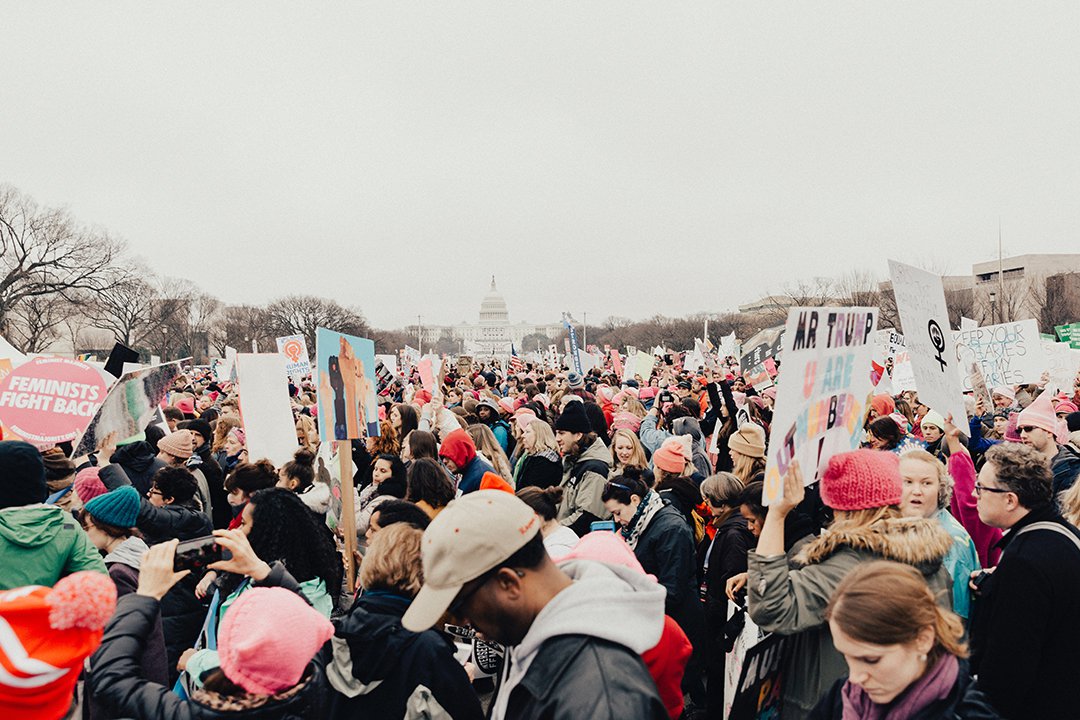
Whenever the newest term catches on, suddenly everyone wants to puff out their chest to flaunt their buttons鈥斺�淣asty Woman鈥濃�攐r slap stickers on their computers鈥斺�淎sk Me 麻豆果冻传媒 My Feminist Agenda.鈥� Since November鈥檚 surprise election, 鈥渋ntersectional feminism鈥� has been one of those terms. But the term, it should come to the surprise of no one, is much more than that. And living under the Trump administration has brought many people to this realization, and opened their eyes to the discrimination and inequality taking place across American society.
Yet these are by no means new revelations. Rather, the recent attacks on , , and have simply made it crystal clear, for the previously uninitiated, just how dangerous it is not to address the intersectionality of the issues at hand, and how they affect different groups in different ways. When was searched and allegedly raped by police officers, for instance, the silence from social justice organizations demonstrated a failure to use intersectional feminism when it was most needed.
So first things first: What is intersectional feminism?
In 1989, Kimberle Crenshaw the term via her critique of feminist theory and antiracist politics. Through a lens of black women鈥檚 lived experiences, Crenshaw identifies the tendency of feminist theory to view discrimination as a single-axis framework鈥攐ne that, in other words, conditions us to think about disadvantage playing out as a single identity. The hitch, however, is that everyone isn鈥檛 similarly situated, which the single-axis framework doesn鈥檛 see. Imagine you鈥檙e standing at a crossroads between the streets named Race, Gender, Class, and Religion, with cars coming simultaneously from every direction. Which one do you dodge, which one do you stand in the way of? Zeroing in on the most privileged members of a group obscures the experiences of those who are, as Crenshaw sees it, standing at these busy intersections.
Yet in order to understand what intersection feminism is, we must, too, discuss what it isn鈥檛. For one, intersectional feminism isn鈥檛 a buzzword鈥攊t鈥檚 a process, not a term. As by Loretta Ross, intersectional feminism isn鈥檛 for people finally acknowledging white supremacy, and it shouldn鈥檛 be used to brag about one鈥檚 perceived degree of socio-political awareness (or 鈥渨oke-ness,鈥� in the vernacular). Ross recently shone a light on these misunderstandings. As Crenshaw鈥檚 theory caught on, she told us, people applied it only to women of color. And since its use has become more popularized, 鈥渁 common misconception is that all intersectional identities mean the same thing and offer comparable threat levels,鈥� she added. When people apply the term to their identities, Ross warned that they overlook the power differentials of their oppressions.
Take the wage gap. Looking at it one-dimensionally pay discrepancies that women of color face. Black women 64 cents to every one white male dollar. Even worse, Hispanic women 55 cents to every one white male dollar. Identifying as Hispanic and a woman in the U.S. workforce essentially diminishes one鈥檚 worth by 45 cents. A white woman is penalized by gender, but she has the advantage of race. A Hispanic woman, however, is penalized by both race and gender. And a gay black woman is penalized by race, sexual orientation, and gender. These identities aren鈥檛 mutually exclusive, yet when society fails to see that fact, we move backward, only stretching the distancing of some from reaching an equal playing field.
Intersectional feminism, by contrast, is a lens through which we can see multiple forms of discrimination, as well as advantage. As Crenshaw sees it, the way in which people engage with discrimination is different, and more challenging, for people who are subject to multiple forms of exclusion. The United States聽 the highest maternal mortality rate among developed countries. But while this is certainly alarming from a national perspective, try a pregnant black woman in Texas, where the rate of maternal mortality is four times higher for black women versus white women. Without recognizing this disparity, we fail to protect black mothers lives.
Moreover, intersectional feminism is a tool that advocates can use for cross-movement building, coalition formation to fight all forms of injustice. Understanding where, how, and why progressive movements overlap is critical to each movement鈥檚 individual success. For example, the strongest advocates understand how the fight for reproductive justice goes hand in hand with the fight to end police brutality. The agenda of the reproductive justice movement 鈥� hollow鈥� in the face of racist systems of violence and control. Reproductive justice is about individuals having ultimate control over their body鈥攁nd their future. Choices, then, aren鈥檛 made freely if they鈥檙e overshadowed by fear or restrictions stitched into broader social structures.
The movement gets at this very point. It鈥檚 an intersectional movement by a shared vision of a world that ceases rampant, institutional violence against black bodies. The movement is in lifting up the voices of all stripes of black people鈥攊ncluding queer, trans, disabled, undocumented, and others marginalized within the broader ideal of black liberation. It is, at its very core, an inclusive movement. Yet the pushback against Black Lives Matter鈥攊ncluding, most obviously, All Lives Matter鈥攈as been fierce. Counter like this aren鈥檛 new. Crenshaw out how some of the victories of the Civil Rights Movement, such as Brown v. Board of Education, were later turned on their head, such as the twisting of the case into a line of thinking that it鈥檚 discriminatory to take race into consideration at all in school . Of course, the aim of these racial justice movements isn鈥檛 to obscure other identities; it鈥檚 to pull into focus those on the fringes. That shouldn鈥檛 be a controversial aspiration. 聽
Everyone has multiple, crosshatching 聽identities. Looking ahead, especially in a world already mired in social turmoil, recognizing this basic fact will be crucial to building a broader front鈥攐ne that can take down challenges as varied as the people who have to face them.
More 麻豆果冻传媒 the Authors
Elizabeth Morehead
Topics
Related

To Appeal to 鈥淢iddle America,鈥� Creatives and Studios Should Focus on Authentic Work, Family, and Care Stories
Experiment No. 39: Shared Batch Cooking
How to Share the Work of Cooking And Build Community