
Come What May: Embedding Tech Skills for the Future of Work
Some embedded industry credentials can head off the employment perils of cyclicality, automation, and obsolescence
With tuition fees as high as ever and changing drastically or going extinct, colleges and universities are thinking risk-management. Perched on in the country, in North Dakota is in a lucrative but precarious spot. As it trains students in the oilfield skills that can help them strike it rich, its faculty and staff are equally mindful of the predicament students will face when the industry invariably goes south.
Williston State embeds industry credentials into many of its degree programs. Students finishing an associate鈥檚 degree in welding can earn certifications from the American Welding Society (AWS) or American Society of Mechanical Engineers (ASME). IT students can earn a variety of CompTIA certifications to demonstrate their progress and interests. The college鈥檚 primary reason for building programs like this is the same one that led聽Broward College in Florida, the leader of a in supply-chain management (SCM) education, to use an eight-part sequence of industry certifications as the bones of their program.
In the Broward-led LINCS program, industry certifications provide evidence that students can do SCM work, and the associate鈥檚 degree lets employers know that students have broad knowledge and foundational skills in writing, math, and science. Partnered with an academic credential in this way, industry credentials give students several ways to communicate what they know and can do. But in one newer program at Williston State, industry certifications take on a different role, demonstrating specific technical skills that will be valued across sectors of our networked economy 鈥� whichever way the price of oil goes.
Built in 2012 with the help of TAACCCT funding, the Applied Associate of Science (AAS) in Petroleum Production Technology was started to help North Dakotans cash in on the shale oil boom, connecting them to the industry鈥檚 well-paid jobs in construction, extraction, and logistics. The program shares important features with Broward鈥檚 associate鈥檚 in SCM. Students are prepared throughout the course to take industry certification exams. There are early exit points, where students can leave with their industry certifications and an intermediate academic credential if they need to. And, as in all other programs at Williston State or Broward, new students can use current industry certifications towards course credit for prior learning.
The oil business is different from the supply chain business, though, and the programs at Broward and Williston State diverge in important ways, too. Supply chains aren鈥檛 going anywhere 鈥� if a worker loses their job at one company, they can probably find a similar role somewhere else. Oil, on the other hand, is a fickle commodity. Boom and bust are as much a part of the business as , and Williston State鈥檚 staff know their students need to be able to find work outside the industry during downturns.
Oil prices plunged following the Great Recession, for example, then leveled off during recovery, and then dove again in 2015. This might have spelled disaster for Williston State鈥檚 new program 鈥� and for its graduates trying to make a living off a very narrowly targeted degree. What can a worker do with a petroleum technology degree except drill for oil, after all?
If they graduate from Williston State, they can do a lot more. That鈥檚 because the college and its four consortium partners decided to include what Pam Rasmussen, the grant director and a career navigator at the college, calls 鈥渕itigating competencies鈥�: skills that can pay off at any point in a sector鈥檚 business cycle, and indeed in industries across the country.
麻豆果冻传媒 half of the courses in the petroleum tech AAS have to do with the petroleum industry specifically. Some have embedded certifications: pipefitting skills can be validated with the same AWS or ASME certifications, and managerial 鈥渓ease-operators鈥� can become certified . With work experience, the coursework can serve as a first step toward more advanced certifications from the American Petroleum Institute.
The rest of the program might appear more at home in the IT department: networking, programmable logic, and industrial control systems. In fact, petroleum tech students take these courses with IT students, and their inclusion speaks to the complexity of today鈥檚 oil industry. If 鈥渄rilling for oil鈥� conjures the shots of rickety oil rigs in , your stock image is a bit out-of-date.
There are still rigs, of course, but drilling in North Dakota鈥檚 Bakken oil patch is not just a matter of digging straight down. Once the drill bit reaches the correct depth, it must turn and proceed horizontally before a solution of sand, water, and chemicals is pumped into the rock to loosen the 鈥渢ight鈥� oil it contains. Drilling to the right depth and pumping the right volume and mixture of fracking solution depends on intricate remote sensors mounted on the well equipment, which send data back to control stations across wired and wireless networks. When the well is completed and oil and gas start to flow, another set of sensing, communication, and control systems kick in to keep things running smoothly. These sensors should also alert technicians to pipeline malfunctions, after a rupture in South Dakota early last Thursday.
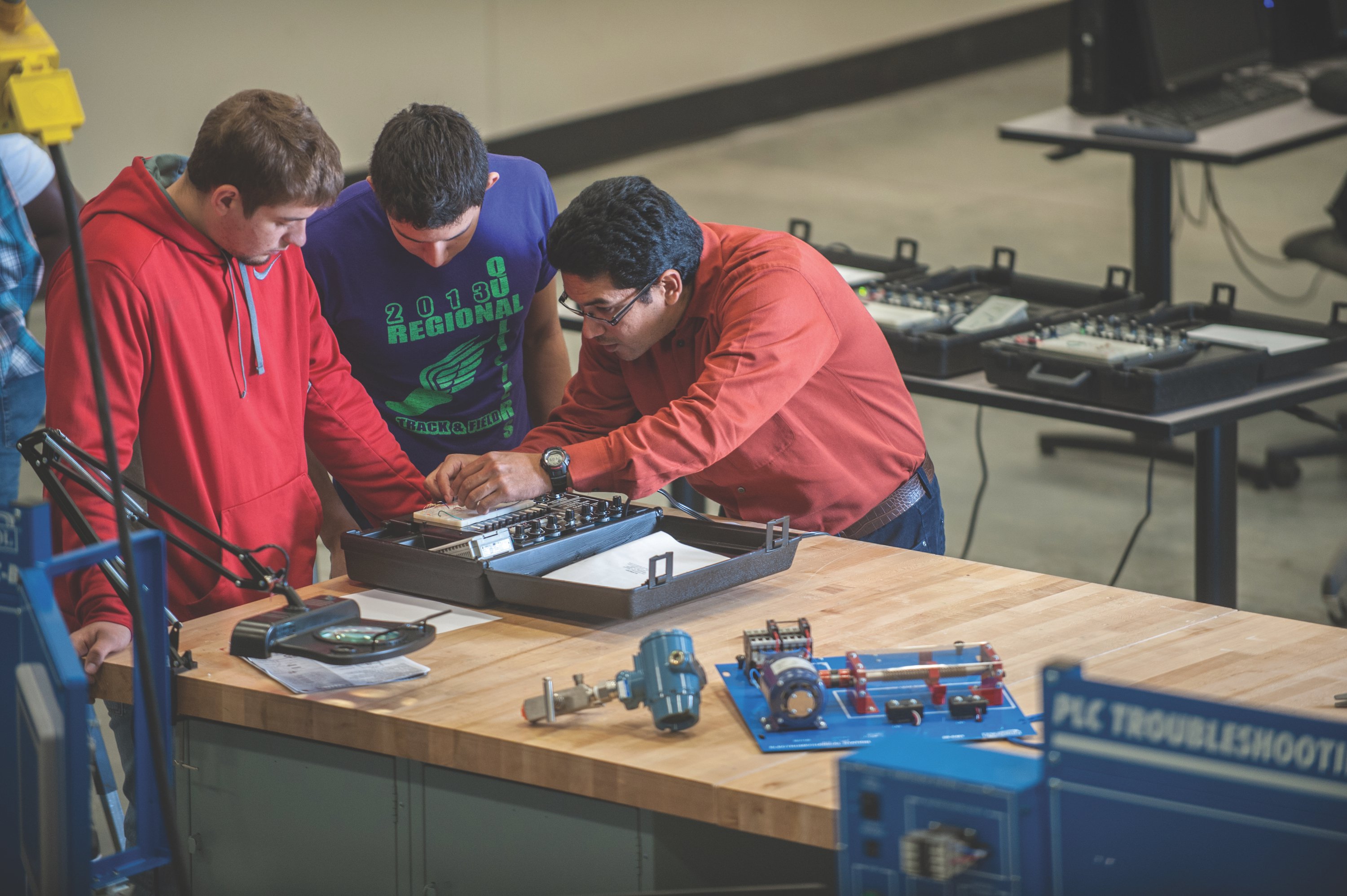
A well-rounded modern oilfield professional can understand and manage all of these networked processes. Achieving that level of knowledge often comes at the price of a bachelor鈥檚 degree in engineering, but Williston State is confident its students are ready with an associate鈥檚. They鈥檙e prepared to earn Cisco networking certifications to prove they can troubleshoot interruptions in the flow of information between the well鈥檚 sensors and its control stations. A more recent addition is preparation for Rockwell Automation鈥檚 , taught on Amatrol simulators, which attest to students鈥� ability to write the machine code that tells the rig how to respond to different inputs. Next year, lead petroleum instructor Alberto Bellina (pictured above, right) plans to embed from the National Institute for Metalworking Skills that will show that students can program and repair the sensors themselves. After that, he鈥檚 looking to robotics.
Ken Quamme, the chair of the business technology department, has led the cross-linkage of petroleum and IT programs. To support the programs鈥� material needs (Amatrol simulators aren鈥檛 cheap) and to defray student expenses on exams, he scours the region鈥檚 business community to find employers willing to chip in to support their workforce. A network architect himself, he also works to show faculty and students how niche-seeming IT skills are used across the economy. That can mean anything from informal chats to webinars to field trips at local power plants, wastewater facilities, and industrial control firms like .
The networking and automation processes learned by Williston State鈥檚 petroleum tech graduates are indeed complicated, but they鈥檙e not esoteric. Some methods for laying underground utility cable are practically identical to drilling an oil well. Programmable logic controllers 鈥� sometimes the very same Rockwell Automation units 鈥� govern the machinery of food processing and advanced manufacturing facilities. And the massive combines and irrigation systems that drive modern agriculture are controlled not by humans at a wheel, but by computer instructions derived from similar networks of sensors.
So if the oil market tanks, laid-off graduates can get similar jobs as automation or industrial maintenance technicians in a completely different sector. When widespread adoption of electric vehicles like finally sound the death knell for oil, it could be Williston State petroleum techs servicing that build the fleet. In the meantime, they鈥檙e trained to satisfy , and to respond as efficiently as possible when it leads to dangerous and inevitable mishaps.
For Williston State鈥檚 petroleum tech students, then, their choice of major doesn鈥檛 mean a narrower field of career options. On the contrary, by embedding industry credentials that teach students to control the same systems that many Americans fear may automate them out of jobs, Williston State lets them both take advantage of the oil industry鈥檚 booms and stay afloat in sectors that will keep chugging during its busts. When industry credentials validate technical skills that will be in demand across tomorrow鈥檚 economy, choosing a program with those credentials built in doesn鈥檛 have to mean committing to one niche.
More 麻豆果冻传媒 the Author
Issues
Programs/Projects/Initiatives
Related

Commerce Department鈥檚 Regional Tech Hubs 鈥� Where Do They Stand Today?

Announcing the 麻豆果冻传媒 & ACCT Work-Based Learning Capacity Building Cohort

Workforce Pell Is Live. Here’s How States Are Approving Programs
