Lisa Guernsey
Senior Director, Birth to 12th Grade Policy; Co-Founder and Director, Learning Sciences Exchange
How do China and the United States stack up when it comes to early education? In two recent pieces — an article for 聽The American Prospect, 鈥�,鈥� and a — I found that although the two countries both struggle to provide good programs for all children, they are also poised to aim high and learn from each other.
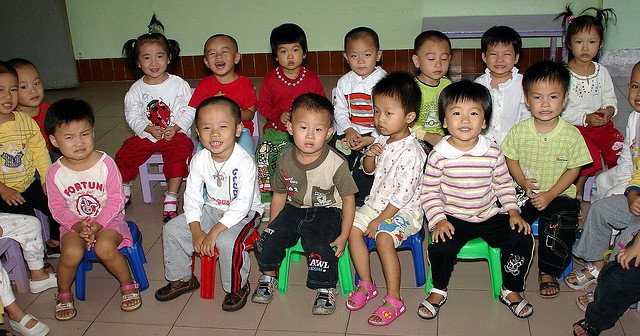
Over the past three years, China鈥檚 leadership has made a concerted effort to increase access to what we might call 鈥減reschool鈥� or 鈥渒indergarten鈥� for all Chinese 3, 4 and 5 year olds. In a 2020 plan adopted in September 2012, China called for each of the country鈥檚 more than 2,800 counties to create a proposal for funding and implementing three years of preschool. 聽By November last year, every county had submitted a document on how they would achieve this goal, and Liu Yandong, Vice Premier for the People鈥檚 Republic of China, came to the United States to talk about the importance of early education and describe the progress China is making. As she announced in , enrollment has climbed to 64.5 percent of all Chinese children, nearly 14 percentage points higher than three years ago.
Yet, like the United States, China still has a long way to go. In a recent , a division of Economist magazine, the United States ranks 聽24th (tied with United Arab Emirates), while China ranks 42nd on the 鈥渙verall preschool environment.鈥�
And as with any question of education access, it鈥檚 not just about how many children are allowed in the door, but what they are learning when they get there. There are signs, however, that China is taking quality seriously. The country鈥檚 leaders recently approved a set of new early learning 鈥済uidelines鈥� that are based in part on what American scholars have determined to be appropriate expectations for children. (Here in the United States, nearly all states have adopted similar guidelines or 鈥渟tandards,鈥� though there are huge gaps in how states are ensuring that publicly-funded teachers are equipped to help their children meet those standards and measure success.)
The Chinese guidelines describe what children should know and be able to do at age 3, age 4 and age 5, but they are not overly prescriptive. Words like 鈥渆xpression鈥� and 鈥渃reation,鈥� for example, feature prominently in the section on arts, a sign of how much China wants to dispel the notion that it is raising automatons. 鈥淭o avoid to suppress young children鈥檚 imagination and creativity,鈥� states an English version of the guidelines, 鈥渁dults should not use their own standards to judge the work of young children, or even train them using a 鈥榦ne size fits all鈥� approach only for the sake of 鈥榩erfect鈥� results.鈥� Other sections lay out expectations for children to develop a love of learning and discovery.
Here鈥檚 more from the :
Consider the teaching of math in China. Parents in urban areas are often characterized as being especially concerned about whether their children are learning mathematical concepts. One might assume, then, that China will expect little kids to become math robots. But the new guidelines are not about drill and practice. They don鈥檛 even emphasize counting to 10 or 20. 鈥淢athematical learning鈥� is in the science section, where the goal is to have children 鈥渂egin to sense the usefulness and fun of everyday mathematics.鈥� For four-year-olds, the expectation is that children will 鈥渦nder guidance realize and discover that many objects in life can be described with numbers鈥� and that children will show an interest in exploring the implications of numbers and measurements.
In a podcast last week for the (麻豆果冻传媒鈥檚 multimedia magazine), I explored this issue with Hao Wu, a 麻豆果冻传媒 fellow who is creating documentaries revealing the complexity of modern China. Hao described what early education looked like several decades ago when he was growing up in China — and how things have changed. In our (starting at the 14:55 minute mark), Wu says many parents in China today resort to using connections and bribes to find a kindergarten for their children. He is 鈥渃autiously optimistic鈥� that the Chinese 2020 plan will alleviate those problems. 聽Yet he sees many of the same implementation and quality-measurement challenges that afflict the United States.
The conversation ushers in visions of a China-US early ed matchup: Which country will be able to truly address those challenges? Which approach — China鈥檚 top-down pushes or the U.S.鈥檚 decentralized and uneven state efforts– will prove to be most successful? Let鈥檚 hope the two countries can learn from each other as China鈥檚 initiative unfolds.”
Senior Director, Birth to 12th Grade Policy; Co-Founder and Director, Learning Sciences Exchange